


Introduction
Many people reject overt racism. Laws and public expectations have changed, and generations of people have challenged racial discrimination. So why does racism still exist? If the problem is widely condemned, why haven't those changes eliminated the inequalities associated with it?
The answer is not that nothing has changed, or that every unequal outcome proves racism. It is that social change is uneven. Laws can change faster than the distribution of resources built under earlier rules. Institutions can keep familiar routines after their original justifications fade. People can sincerely value equality while overlooking how ordinary practices affect others. And when one mechanism changes, other mechanisms may remain.
To follow the question, we will return to a hypothetical hiring process. Imagine an employer who genuinely wants to choose the strongest candidate and rejects explicit racial prejudice. The employer relies on credentials, prior experience, professional networks, and a sense of “fit.” None of those criteria proves racism by itself. But by examining how the criteria were chosen, who had access to the experiences they reward, and how they are applied, we can see why good intentions alone do not settle the question.
This recurring example is a way to explore the problem, not evidence about any real employer. The larger question is how historical legacies, institutional routines, incentives, and learned meanings can continue to shape outcomes—and how those mechanisms can be investigated and changed.
Why doesn't a change in the law erase what came before?
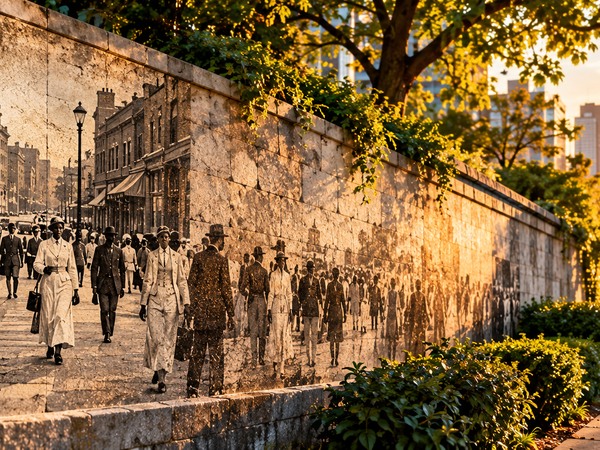
A law can change more quickly than the social and economic conditions built around it. When a discriminatory rule is repealed, the effects of earlier exclusion do not necessarily vanish at the same moment. Wealth, housing, education, professional networks, institutional reputations, and access to resources can accumulate over time. Those resources can affect later opportunities, even when the original rule is no longer in force.
This is one reason historical analysis matters. The present is not independent of the processes that produced it. To understand a contemporary pattern, researchers may need to examine the earlier laws, institutions, and social arrangements that shaped the distribution of resources and opportunities.
Return to the hiring example: candidates may arrive with different access to internships, prestigious credentials, or professional contacts because opportunities were distributed unevenly before the application process even began. That possibility does not tell us how any particular candidate should be evaluated; it tells us to examine how the employer’s criteria connect to the opportunity being assessed.
This does not mean that history mechanically determines the future or that every present-day disparity can be attributed to one historical cause. Historical legacies work through specific mechanisms, which must be identified and supported with evidence. The relevant question is not simply whether a historical injustice occurred, but how its consequences were transmitted, altered, challenged, or reinforced over time.
Key idea
Racism can persist not because nothing has changed, but because laws, institutions, resources, and learned assumptions change at different rates.
If explicit racism becomes less acceptable, how can inequality continue?
Racism is not a single practice that either exists or disappears. Its expression can change with law, political conflict, public norms, and institutional incentives. When explicit racial exclusion becomes less acceptable, racial inequality may still be reproduced through indirect practices, ostensibly nonracial explanations, or routines that are difficult to recognize as racialized.
Bonilla-Silva's work on color-blind racism describes how racial inequality can be justified through frames and accounts that minimize the significance of race while leaving unequal arrangements insufficiently examined (Bonilla-Silva 2006, 2015). The point is not that every statement about individual responsibility, merit, or neutrality is necessarily a racial defense. It is that explanations should be examined in context: what do they account for, what do they leave out, and how do they relate to observable patterns?
A system can also adapt because people and organizations respond to change. A reform may alter one mechanism while leaving other mechanisms intact. An institution may adopt new language while retaining familiar decision-making routines. A policy may reduce one form of unequal treatment while creating new questions about implementation or enforcement. These are possibilities to investigate, not proof that every reform fails or that all change is merely cosmetic.
Can a system reproduce inequality without one person planning it?
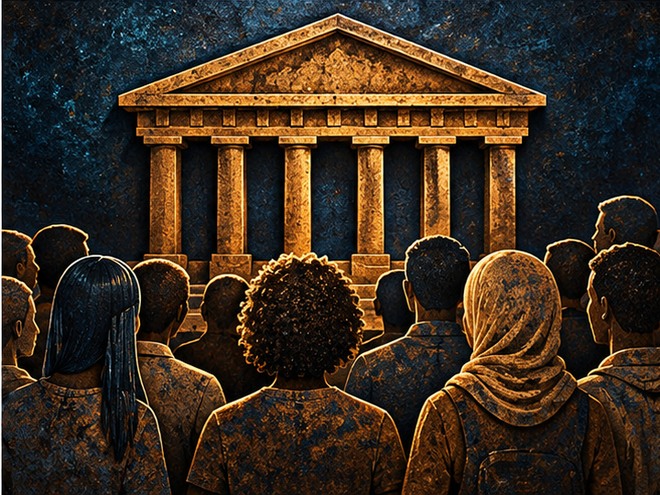
Racial inequality does not require every participant to share the same beliefs or coordinate their actions. Institutions contain routines, incentives, categories, evaluation criteria, and expectations that can persist beyond the people who established them. People entering an institution learn how it works and may reproduce its practices because those practices are familiar, rewarded, required, or treated as common sense.
This helps explain how someone can oppose racism in principle yet participate in a process that contributes to unequal outcomes. A manager may value fairness but rely on hiring signals that favor applicants with access to particular resources. A school may endorse equal opportunity while using practices whose effects it has not examined. A public agency may apply established procedures without considering how they interact with unequal exposure to scrutiny or penalties.
The existence of an institutionally reproduced pattern does not automatically tell us why it occurs. Careful analysis must establish the process, evidence, and causal explanation. But the absence of a single malicious decision-maker is not enough to rule out institutional mechanisms.
In the hiring example, the employer does not need to coordinate with other employers or intend to exclude anyone for a familiar recruitment routine to favor people who already have access to the same networks. Whether that happens in a real case must be established with evidence about the process and its outcomes.
Who benefits from the way things already work?
Persistence can also be reinforced by incentives. Some individuals and groups receive material or social advantages from existing arrangements, and they may have reasons to resist changes that threaten those advantages. The benefits are not always direct financial rewards. They may include access to networks, social status, a sense of belonging, confidence that one's qualifications will be recognized, or reassurance that one's group is deserving or superior.

Key idea
Ending a discriminatory rule does not automatically erase the resources and opportunities accumulated under earlier arrangements.
These incentives do not mean every member of a socially advantaged group is wealthy, secure, or consciously committed to racial inequality. Social advantage is contextual and can coexist with serious hardship. A person can face economic insecurity and still benefit from some racialized assumptions or institutional practices in a particular setting. Conversely, membership in a racial group does not guarantee the same resources or outcomes for every individual.
The task is to specify the advantage and the context rather than treat privilege as an all-purpose label. Which opportunity, presumption, protection, or resource is at issue? Who receives it? Who does not? What evidence shows that race contributes to the difference?
How can inequality start to look natural or deserved?
Institutions do not operate through rules alone. They also depend on meanings: beliefs about who is competent, dangerous, trustworthy, deserving, hardworking, or suited to lead. These ideas can make existing arrangements appear natural or justified.
When people repeatedly encounter racial categories alongside familiar stereotypes, those associations can become taken for granted. People may interpret unequal outcomes as evidence of inherent group differences while overlooking unequal opportunities, institutional decisions, or the history that shaped those outcomes. In this way, a social arrangement can help produce a pattern and then be invoked as an explanation for why that pattern supposedly exists.
Racial ideology can therefore help stabilize inequality by shaping how people interpret evidence. A person may see a disparity but attribute it entirely to individual choices. Another may recognize a historical injustice but assume that formal legal equality has already removed its effects. These explanations may sometimes capture part of a situation, but they become inadequate when they are used without examining relevant evidence and alternative explanations.
Why can racism be hard to recognize, especially when we mean well?
People do not observe society from outside it. We learn categories, assumptions, standards, and expectations through family, education, work, media, law, and everyday interaction. Those influences help us interpret the world, but they can also make some patterns easier to see than others.
This is the connection between recognition and misrecognition. Recognition makes social life intelligible by allowing us to identify people, situations, and relationships. Misrecognition occurs when our interpretations are mistaken or when socially produced meanings are treated as natural properties. In racial contexts, people may misrecognize a stereotype as a fact about a group, or misrecognize an established institutional routine as neutral simply because it is familiar.
The problem is not that human beings can never recognize their own assumptions. People can reflect, learn, compare experiences, and revise their views. The problem is that self-assessment has limits, especially when the assumptions under examination are socially reinforced or when acknowledging them threatens a valued self-image.
This is one reason evidence and outside perspectives matter. They can reveal patterns that are difficult to identify from personal intention or experience alone. Research does not remove every disagreement, but it can make claims testable and give people a basis for revising assumptions.

Key idea
When explicit racism becomes less acceptable, inequality may continue through indirect practices and familiar routines—but each proposed mechanism must be tested with evidence.
Why aren't good intentions enough?
Many people sincerely believe in equal treatment. They may oppose overt racism, reject racial slurs, and regard themselves as fair-minded. Yet a commitment to equality in principle does not guarantee that every practice they support or participate in produces equal treatment in practice.
A person may apply a standard consistently without asking whether the standard measures what it claims to measure. An institution may celebrate diversity while its hiring process continues to reward a narrow set of familiar credentials or cultural signals. A decision-maker may focus on an applicant's apparent fit while overlooking whether that judgment reflects a legitimate job requirement or a preference for similarity.
In our example, the employer may honestly believe that the candidate with the most prestigious credentials is the strongest choice. The next question is not whether the employer is secretly a bad person; it is whether those credentials validly predict performance, whether other relevant abilities are being overlooked, and how candidates had the opportunity to acquire them.
The relevant distinction is between self-image and social consequences. A person's belief that they are fair is evidence about their self-understanding; it is not conclusive evidence about how their decisions operate. Likewise, an unequal outcome warrants investigation but does not, by itself, prove that an individual intended to discriminate.
Wang's study of academic hiring provides a concrete example. Based on interviews with 50 sociology and business professors at seven U.S. research universities, it examines how the evaluation logics of merit, fit, and diversity interact during hiring. The study suggests that evaluative practices can reproduce inequality even when participants understand themselves to be making fair and professionally appropriate judgments (Wang 2025). Its specific sample limits how far its findings should be generalized, but it illustrates why good intentions and formally defensible criteria are not the end of the analysis.
What happens when evidence about racism feels like a personal accusation?
Confronting racism can threaten a person's understanding of themselves as fair, decent, or independent of prejudice. Some people respond to criticism with defensiveness, anger, withdrawal, denial, or a demand that any discussion of racism first establish that they are not personally bad. Such responses can make it harder to examine the evidence or discuss the effects of established practices.
Robin DiAngelo's concept of white fragility is one framework for discussing defensive responses that can arise when White people encounter challenges to racial assumptions or their self-understanding. It is a specific theoretical and educational framework, not a diagnosis that applies identically to every White person or every disagreement. In using it, it is important to describe the behavior at issue and consider evidence rather than treating a person's race as proof that they will respond defensively (DiAngelo, n.d.).
The broader point is not limited to one term. People often resist information that conflicts with their identity, prior beliefs, or sense of deservingness. That tendency can obstruct learning when the subject is racism, especially if the conversation becomes focused entirely on defending or condemning individual character.
Key idea
Institutional patterns can reproduce inequality without a single person planning the outcome, but the process and its causes still need to be demonstrated.
A more productive approach distinguishes accountability from totalizing blame. People can be responsible for harmful actions and still be capable of learning. Understanding how someone acquired an assumption can help explain it; it does not make the consequences disappear or remove the obligation to respond.
Can changing individual attitudes change the whole system?
Individuals can examine their beliefs, question stereotypes, listen to people whose experiences differ from their own, and change how they act. They can challenge unfair decisions, revise their own practices, and help others recognize problems. Such changes matter because institutions are enacted through people.
But individual change alone cannot address every source of inequality. A person can become more aware while remaining inside an organization whose procedures and incentives continue to produce the same patterns. A group can adopt new values without changing how it allocates resources or evaluates people. This is why individual reflection needs to connect to collective and institutional action.
Institutional change may involve revising criteria, improving transparency, examining outcomes, changing enforcement, expanding access to relevant resources, and creating ways to challenge decisions. The appropriate response depends on the institution and the mechanism identified. Reforms should be assessed by evidence about what they change, for whom, and with what unintended effects.
Collective action also matters because institutions and social systems are larger than any one individual. People can work together to alter laws, expectations, policies, and organizational practices. Historical movements have changed institutions and expanded rights, even as the effects and durability of those changes have varied. Acknowledging setbacks should not erase genuine gains.
What if race is only part of the explanation?
Racism is connected in different ways to class inequality, sexism, patriarchy, heteronormativity, transphobia, xenophobia, religious discrimination, and colonial relations. These systems can reinforce one another, but they are not identical. Their relationships vary across time, place, and institution.
An approach informed by intersectionality asks how multiple relations of power shape a particular outcome. It avoids assuming that all members of a racial group experience inequality in the same way or that racism can always be understood without considering gender, class, nationality, or other relevant factors (Collins 1998).
This complexity is another reason a single explanation or intervention will rarely be enough. An intervention that addresses one mechanism may leave others untouched. Effective analysis identifies which systems and processes are relevant to the case, rather than simply listing every form of discrimination.
If there is no single solution, how can change happen?
Racism is historically embedded, institutionally distributed, and capable of changing form. It can be reinforced by material incentives, social identities, normalized ideas, and the participation of people who do not intend to reproduce inequality. These features make change difficult, but they do not make it impossible.
A useful starting point is recognition: acknowledge that a problem may exist, investigate who is affected and how, and examine the evidence rather than relying only on intention, familiar explanations, or political identity. From there, different responses can be evaluated at different levels. Individuals can change their conduct; organizations can examine and revise their practices; and collective action can challenge laws, policies, and wider arrangements.

Key idea
To analyze advantage carefully, identify the specific resource, opportunity, or presumption at issue and establish who receives it and why.
The goal should not be to assume that every reform works or that any one approach will end racism. It should be to identify mechanisms, choose responses that address them, evaluate the results, and adapt when evidence shows that something is not working. The fact that a system adapts is a reason for sustained attention, not a reason to abandon the effort.
What can we do with this understanding?
Racism can persist even when it is widely condemned because social change does not reach every institution, incentive, routine, and learned assumption at once. Historical legacies, institutional practices, unequal advantages, racial ideology, misrecognition, and defensive responses can interact, but no one factor explains every case. Each proposed explanation must be examined against evidence.
Understanding these processes does not require declaring people inherently bad, and avoiding totalizing blame does not require excusing harmful conduct. People can acknowledge the influence of socialization, take responsibility for their actions and their consequences, and work collectively to change the arrangements that reproduce inequality.
Above all, follow the evidence. Ask what is happening, how it happens, who is affected, what explanations fit the facts, and whether proposed changes make a meaningful difference. Racism was made through historical and social processes; those processes can be challenged and changed.
Continue exploring: How Racism Works · Race and Racism Aren’t What You Think They Are
Selected references
- Bonilla-Silva, Eduardo. 2006. Racism without Racists: Color-Blind Racism and the Persistence of Racial Inequality in the United States. 2nd ed. Lanham, MD: Rowman & Littlefield.
- Bonilla-Silva, Eduardo. 2015. “The Structure of Racism in Color-Blind, ‘Post-Racial’ America.” American Behavioral Scientist 59(11):1358–1376. https://doi.org/10.1177/0002764215586826
- Collins, Patricia Hill. 1998. “It’s All in the Family: Intersections of Gender, Race, and Nation.” Hypatia 13(3):62–82.
- DiAngelo, Robin. n.d. “White Fragility and the Rules of Engagement.” Supplied educational handout.
- Feagin, Joe R. 2006. Systemic Racism: A Theory of Oppression. New York: Routledge.
- Omi, Michael, and Howard Winant. 2014. Racial Formation in the United States. 3rd ed. New York: Routledge.
- Wang, Leping. 2025. “Unpacking Merit, Fit, and Diversity: A Multifaceted Framework to Academic Gatekeeping in Social Sciences at U.S. R1 Research Universities.” Sociological Inquiry. https://doi.org/10.1111/soin.70026
About the Author
Learn more about Dr. DaShanne Stokes’s background in the biography and explore related scholarship on the research page.